5 Web Development Trends Shaping 2026 (And What They Actually Cost US & Canadian Businesses)
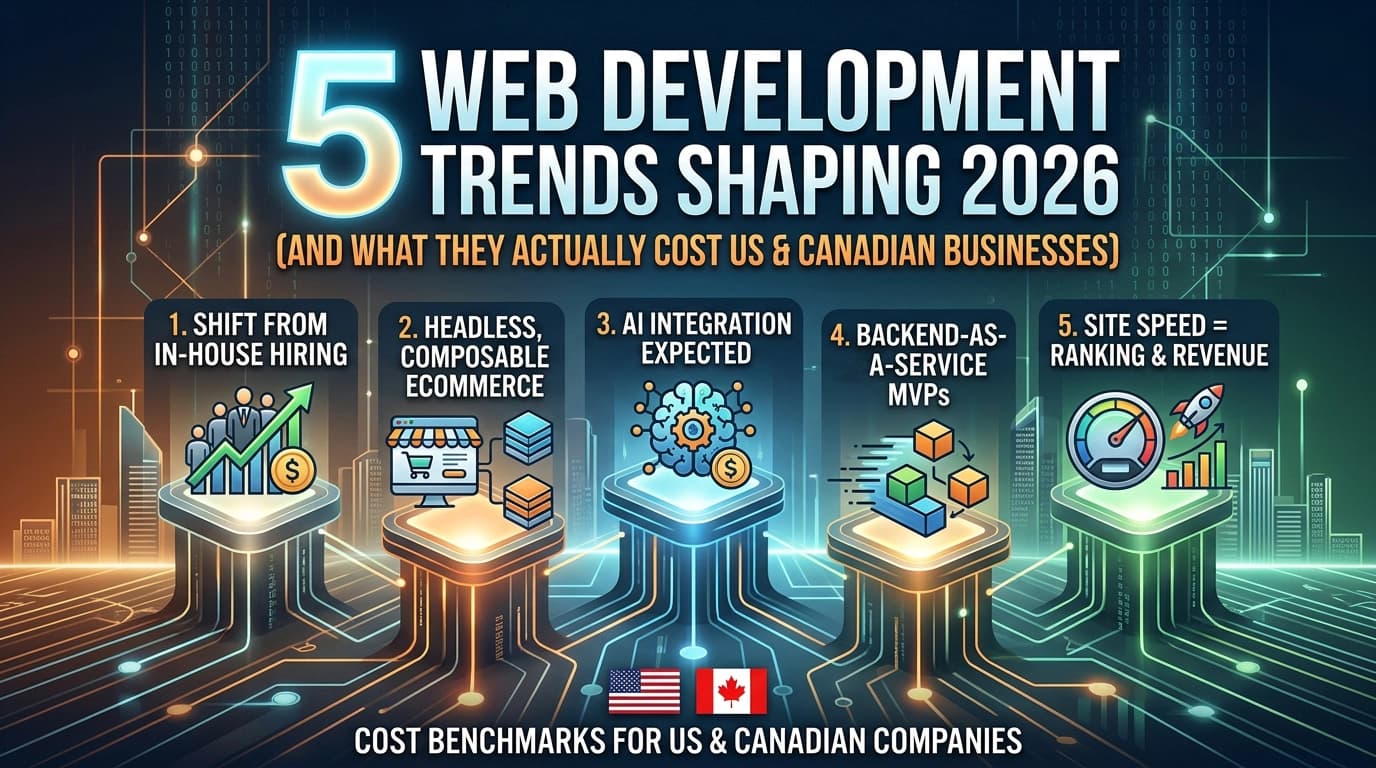
If you're planning to build, rebuild, or scale a website or platform this year, 2026 is a genuinely different landscape than it was even two years ago. Below are the five shifts that matter most if you're a US or Canadian business owner weighing your options — and what each one is likely to cost you.
1. Businesses Are Quietly Moving Away From In-House Hiring
The math on in-house development has gotten harder to justify for most businesses. Once you add salary, benefits, payroll taxes, tooling, and recruiting costs, a fully loaded US developer typically runs $100,000–$300,000+ per year — and that's before accounting for the 3–8 months it usually takes to post the role, hire, and get someone fully productive.
That's a big part of why more companies are shifting toward flexible hiring models: dedicated developers, boutique agencies, and vetted freelancers who can start in weeks instead of months and scale up or down with the work. You get senior-level output without carrying a full-time salary through the slow months.
What this means for you: if you don't have continuous, year-round development needs, a dedicated developer or small agency almost always beats hiring in-house on both cost and speed to launch.
2. Headless, Composable Storefronts Are Becoming the Baseline for Ecommerce
Traditional theme-based Shopify stores tend to plateau in performance once an app stack gets heavy. Headless setups — pairing a Next.js frontend with Shopify's Storefront API or Hydrogen — are consistently landing much higher performance scores, and that gap now shows up directly in conversion rate, not just page-speed reports.
Shopify's own platform updates this year made headless easier to adopt than before, decoupling its tooling so it plays natively with Next.js rather than locking teams into one framework. It's generally worth it once a store is doing meaningful revenue or is visibly bottlenecked by load times — smaller stores are usually better off optimizing their existing theme first.
3. AI Integration Has Gone From "Nice to Have" to Expected
Buyers evaluating a new platform in 2026 increasingly expect some degree of AI built into the product itself — not just AI-assisted coding on the dev side, but AI-powered dashboards, forecasting, automation, or personalization inside what they're paying for. Teams that can build this well, rather than bolt on a chatbot widget, stand out.
4. Backend-as-a-Service Is Cutting MVP Timelines Down Significantly
Tools like Supabase let a team stand up authentication, a database, and real-time features without building backend infrastructure from scratch. For early-stage SaaS products especially, this is shortening typical MVP timelines and lowering the upfront cost of getting a first version in front of users.
5. Site Speed Is a Ranking and Revenue Issue, Not Just a Dev Concern
Google continues to weight page experience heavily in how it ranks sites, and the conversion data backs it up — even small improvements in load time measurably increase conversion rates. A slow site isn't just an engineering complaint anymore; it's losing you both search visibility and buyers.
What This Means If You're Planning a Build in 2026
Development Hiring Options
Freelancer
Typical Cost: $50–$150/hour (US)
Time to Start: 1–3 weeks
Best for smaller projects, quick development tasks, or when you need specialized expertise without a long-term commitment.
Agency / Dedicated Developer
Typical Cost: $5,000–$150,000+ per project
Hourly Rate: $100–$250/hour
Time to Start: 2–4 weeks
A good option for larger projects that require a complete development team, project management, design, and ongoing support.
In-House Hire
Typical Cost: $100,000–$300,000+ per year (fully loaded)
Time to Hire: 3–8 months
Ideal for companies that need long-term ownership, close collaboration, and a dedicated internal engineering team.
Quick Comparison
Freelancer → Lower initial cost • Faster start • Flexible
Agency / Dedicated Developer → Full-service development • Scalable • Higher investment
In-House Hire → Long-term commitment • Maximum control • Highest overall cost
(Ranges vary by scope, seniority, and location — treat these as general 2026 market benchmarks, not quotes. Worth updating with a current source, e.g. Clutch or BLS, before you publish.)
For most small-to-mid-size US and Canadian businesses, a specialized dedicated developer or boutique agency hits the sweet spot: senior-level, US-quality output without the fully loaded cost of an in-house hire or the inconsistency risk of a generalist freelancer.
Ready to Build (or Rebuild) for 2026?
I work with React, Next.js, Shopify, WordPress, and Supabase everything covered above, from headless commerce builds to AI-integrated dashboards to fast SaaS MVPs. If you're weighing your options for a new site or platform this year, get in touch or take a look at recent projects.